
Short answer
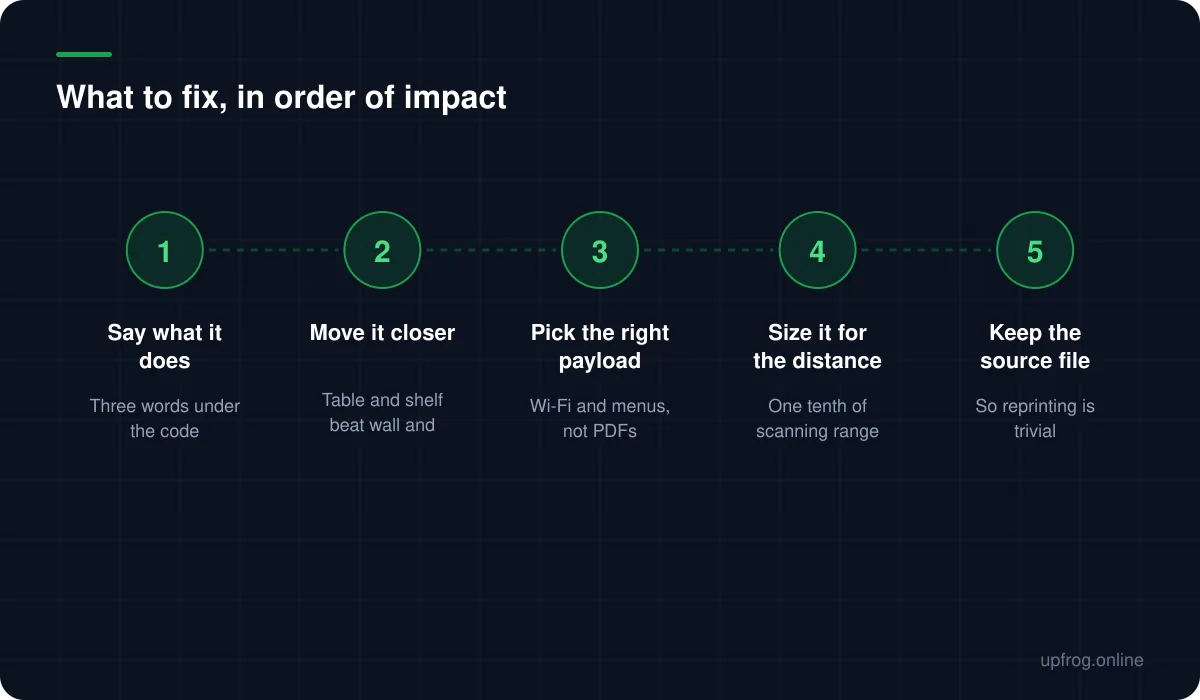
The single biggest improvement is telling people what happens when they scan. A code labelled 'Scan for the menu' massively outperforms a bare code. After that, placement matters more than design: put it where the customer is already sitting still with a free hand.
Tell people what happens next
A bare QR code is a question mark. Scanning one is a small gamble: it might be a menu, might be a survey, might be a marketing list you cannot leave.
Adding three words underneath removes the gamble. 'Scan for the menu.' 'Free Wi-Fi here.' 'See allergen info.' It sounds almost too simple to matter, and it is consistently the change that moves the numbers most.
The same logic applies to the destination. If someone scans expecting a menu, they should land on a menu — not a homepage with a menu link buried in it.
Put it where the phone already is
Table tents beat wall posters. Receipts beat table tents. The best placement is wherever the customer is already sitting still with a free hand and a moment to spare.
In retail, the shelf edge outperforms the packaging, and the packaging outperforms the window. A code in a shop window has to survive glare, a passer-by's walking pace, and the awkwardness of stopping in the street to photograph a shop.
Height matters more than people expect. A code at knee level or above eye level asks the customer to crouch or stretch, and most simply will not.
Choose the payload that removes the most friction
The most valuable QR code in most venues is the one nobody prints: Wi-Fi access. A Wi-Fi code replaces an entire conversation, a handwritten password on a chalkboard, and a staff interruption. It is a genuine, repeated saving every single day.
Menus are the obvious one, but the execution is often wrong. A code pointing at a PDF opens a document viewer, arrives at the wrong zoom, and needs pinching and dragging on a phone. Point at a plain mobile-friendly web page instead.
- Wi-Fi access — no typing, no staff interruption, works instantly.
- Menu or catalogue — a real web page, never a PDF.
- Review link — straight into the review form, not your homepage.
- Loyalty sign-up — one field, not a full account creation flow.
Plan for the reprint
Whatever you print will be wrong within a year. The menu changes, the promotion ends, the Wi-Fi password gets rotated after someone shares it.
So make regeneration trivial. Keep the SVG source, write down the exact payload somewhere findable, and note the design settings. A code that lives only inside a departed designer's layered file is a code you will end up rebuilding from a photograph.
This is also a decent argument for pointing codes at a path on your own domain, so the printed artwork never has to change even when the destination does.
A short checklist before you print a hundred of them
Five minutes here saves an entire print run.
- 1
Scan it yourself on two different phones
One iPhone, one Android, both from the distance a customer will use.
- 2
Check the label says what happens
Three words minimum. If a stranger cannot predict where it goes, rewrite it.
- 3
Test the destination on a phone, not a laptop
This is where PDF menus fall apart.
- 4
Print one on the real material
Laminated table tents and glossy card behave very differently to office paper.
- 5
File the source
SVG plus the payload text, somewhere the next person will find it.
Frequently asked questions
- Should a restaurant menu QR code be static or dynamic?
- Static, pointing at a stable URL on your own domain. You can change what lives at that URL whenever the menu changes, without reprinting and without paying a subscription for the privilege.
- What size should a table QR code be?
- Around 2 to 3cm across is comfortable for a table tent read at roughly 30cm. Scale up for anything read from further away — roughly one tenth of the scanning distance.
- Do QR code menus put customers off?
- The code itself rarely does; the destination usually does. A slow PDF that needs zooming frustrates people. A fast, plain, mobile-friendly page does not. Keeping a few paper menus for those who prefer them costs almost nothing.
Sources
Specifications and primary documentation referenced above.